What Should You Check Before Ordering a Custom Inflatable Tent?
What Should You Check Before Ordering a Custom Inflatable Tent?
Before ordering a custom inflatable tent, confirm the tent size and configuration, 3D visual, production artwork, brand colors, logo and graphic positions, quantity, and event date.
These details should be settled before production begins.
A custom inflatable event tent is not produced from a logo file and a size request alone. The finished structure combines dimensions, openings, printing, branding positions and event timing. If one of these elements changes late, other production details may also need to change.
The purpose of pre-production approval is straightforward: the buyer and the production team should be working from the same final information before manufacturing starts.
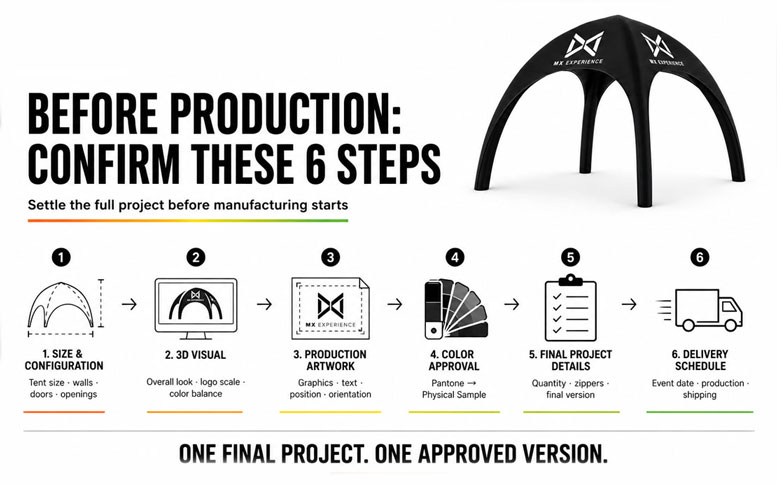
For most custom projects, the review should follow this order:
Size and Configuration → 3D Visual → Production Artwork → Color Approval → Final Project Details → Production and Delivery Schedule
If you are still deciding which tent to buy, our inflatable event tent buyer's guide covers structure selection, materials, pricing and supplier evaluation before you move into the production approval process.
Confirm the Custom Inflatable Tent Size and Configuration
Confirm the tent size before final production artwork is prepared.
Moving from a 3 × 3 m tent to a 4 × 4 m tent is not simply a matter of enlarging the graphics.
Panel dimensions change. Logo proportions may need adjustment. Openings and usable print areas can shift as well.
The main configuration should be confirmed at the same stage.
Check:
- tent size
- walls and doors
- openings
- zipper positions
- quantity
- other measurable configuration details that affect production
If the size is still undecided, resolve that first.
The decision should consider the available event footprint, usable interior space, furniture or equipment inside the tent, access requirements and the visual scale required at the venue.
For a detailed sizing method, see our inflatable tent size guide.
The production principle is clear:
Final artwork should be created for the final tent dimensions, not for an earlier size that may still change.
Review the Custom Inflatable Tent in 3D Before Production
Use the 3D visual to review the complete inflated structure before production.
Do not evaluate the branding only as flat artwork.
Check:
- overall proportion
- logo scale
- color distribution
- main viewing sides
- doors and openings
- how different branded surfaces work together
An inflatable tent includes roofs, beams, legs and curved surfaces. A logo that looks balanced on a flat design can appear oversized, crowded or badly positioned once it is applied to the inflated structure.
The same issue can occur when graphics continue across several surfaces.
For a custom printed inflatable tent, the important question is not simply whether the artwork looks good on screen. The buyer needs to understand how that artwork will work on the complete three-dimensional structure.
That is the purpose of the 3D review.
It allows the buyer to judge the overall visual result before the project moves into production.
But the role of the 3D visual should remain clear:
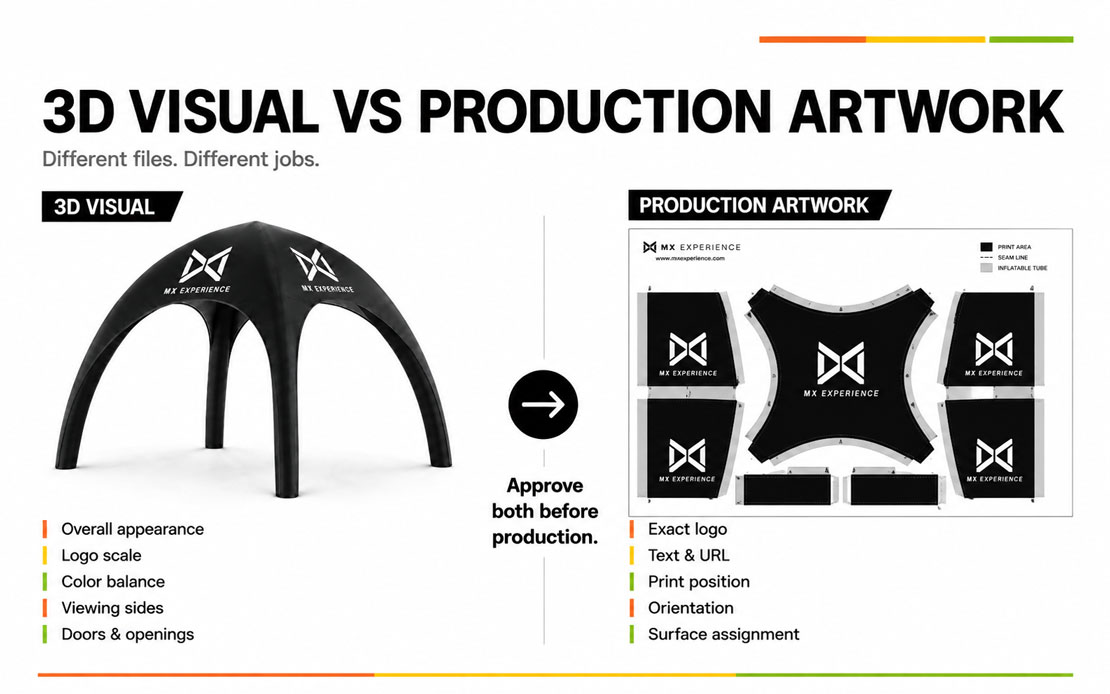
A 3D visual confirms the overall appearance. It does not replace the production artwork.
For more detail on logo proportion, visual balance and finished appearance, see How to Make a Custom Inflatable Tent Look Professional at an Event.
Approve the Final Custom Tent Artwork and Design Proof
A 3D visual and production artwork serve different purposes.
The 3D visual shows how the finished tent should look. Production artwork defines what will actually be printed and produced on each surface.
The production artwork therefore requires a more detailed review.
Check the final:
- logo version
- graphics
- text
- spelling
- URLs
- event names
- print positions
- orientation
- content assigned to each printable surface
If the tent includes a slogan, website address, campaign message or event name, the customer should check it before production approval.
The same applies to graphic placement.
Front, rear, left and right sides should be clearly identified. Roof graphics, inflatable beams, legs and sidewalls should also be shown where they are printed.
The buyer should not need to guess which design belongs to which surface.
The exact document name may vary between suppliers, but the purchasing principle does not:
Manufacturing should proceed from the latest reviewed production version, not from an early design concept.
What Artwork Files Should You Provide?
Provide the best original artwork available.
Vector artwork is normally preferred for logos because it can be enlarged for large-format printing without the same loss of sharpness that occurs when a small raster image is enlarged.
If the customer has the original source file, MX asks for that file first.
If no usable source artwork exists, the MX design team can redraw the logo before preparing the production layout.
The reconstructed artwork is then sent back to the customer for review.
Receiving “a logo” is therefore not enough. The artwork needs to be suitable for the actual size and printable surfaces of the tent.
If you already have a logo and tent size, MX can help prepare the 3D visual and production artwork for review before production.
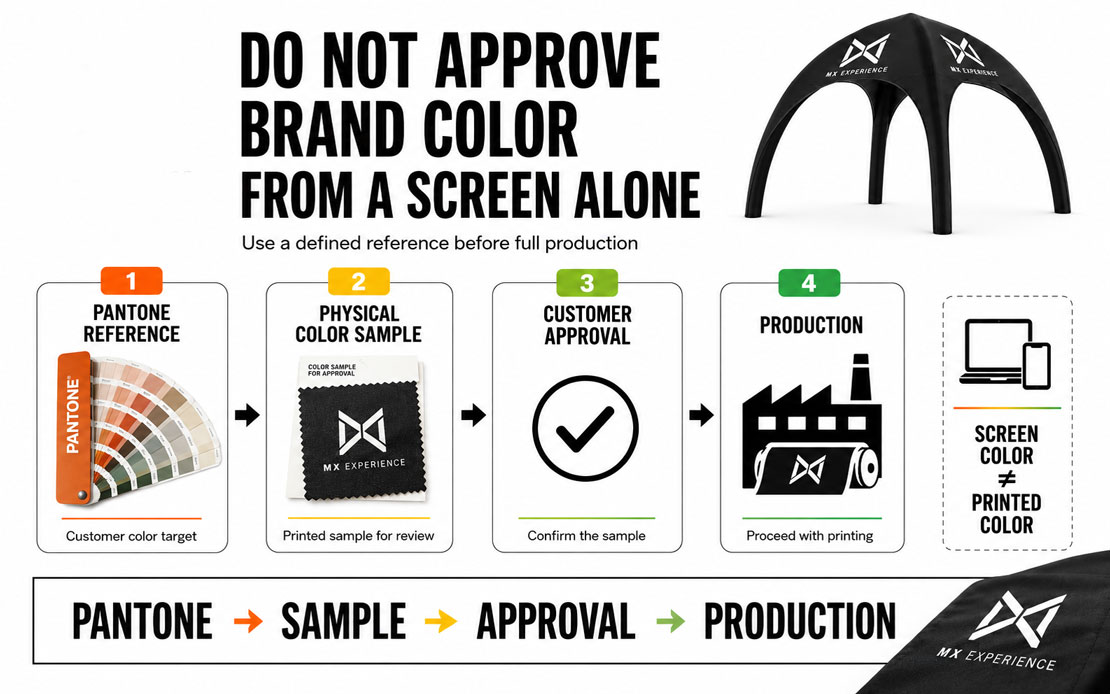
Confirm Pantone Colors Before Custom Tent Printing
Do not approve an important brand color from a phone or laptop screen alone.
A defined color reference gives the buyer and supplier a clearer production target.
For MX projects, the customer normally provides the Pantone reference.
That reference may come from an existing brand guideline or from the visual requirements of a particular event.
For example, a brand activation may require the tent to coordinate with signage, vehicles, display counters or other campaign materials.
MX normally prepares a physical color sample before full production.
The process is:
Customer Pantone Reference → Physical Color Sample → Customer Approval → Production
The two references perform different roles.
The Pantone reference establishes the target.
The physical sample allows the customer to review the practical production reference before the full order is printed.
This should not be interpreted as a guarantee of a mathematically identical Pantone result under every condition.
Material, printing process and viewing conditions can influence the final appearance.
The practical objective is more useful: agree on the production color before the complete order is made.
Confirm Logo Placement, Graphics and Openings
Instructions such as “put the logo on both sides” are not precise enough for final production.
The production artwork should show exactly where the logo appears.
It should also show how graphics and text relate to doors, openings, zipper lines and other structural features.
Review each important surface individually:
- front
- rear
- left side
- right side
- roof
- inflatable beams
- legs
- walls
A logo may need a different scale on an inflatable leg than on a large sidewall.
A graphic may also need to move if a door or opening changes.
The final production artwork should therefore show the actual position and orientation instead of relying only on general written instructions.
If a logo position, door, opening or zipper location changes, MX normally updates the production artwork.
A new 3D visual is not required for every minor revision.
If the change affects the overall appearance, or the customer wants another complete visual review, a revised 3D visual can also be prepared.
This keeps the process practical.
The 3D visual is used to review appearance. The production artwork is updated when production information changes.
Check the Final Custom Inflatable Tent Order Details
Before manufacturing begins, the measurable project details should be clear.
For a typical MX project, these include:
- tent size
- configuration
- logo positions
- printable content
- quantity
- opening and zipper details
- final artwork version
This does not mean the customer needs to review every internal manufacturing document.
The purpose is to lock the important buyer-approved information that directly affects the finished product.
This becomes particularly important after several rounds of communication.
An early email may contain a previous tent size. Another message may show an old logo position. A later design may replace an earlier layout.
Production should not depend on somebody reading the complete communication history and deciding which instruction is still current.
The latest approved production information should make that clear.
For buyers considering a custom inflatable X tent, the selected structure, final size and branding layout should all correspond to the same approved project.
Reapprove Any Artwork or Configuration Changes
Changes after approval can be handled.
They simply need to be reflected in the production information.
If the customer changes a logo, graphic, text, opening, zipper position or another production-related detail, MX updates the production file.
The revised version is then sent back to the customer for confirmation.
The process is:
Change Requested → Production File Updated → Revised Version Reviewed → Customer Confirms → Production Continues
This prevents a new instruction from existing only in an email or message while the production file still shows the previous version.
The process does not need to become unnecessarily bureaucratic.
What matters is version clarity.
Any production-relevant change made after approval should appear in the revised production file before manufacturing continues.
For a heavily branded custom inflatable event tent, this is particularly important because several printed surfaces may work together as one visual system.
A change on one surface can affect the layout around it.
For larger projects, the final configuration should also consider whether a single large inflatable tent or several smaller units will work better for future events.
Confirm the Event Date, Production Time and Shipping Plan
Give the supplier the event date before accepting the production schedule.
For event products, asking only:
How many days does production take?
does not give the buyer enough information.
The more useful question is:
Can this order realistically arrive before my event?
MX evaluates the project using three main factors:
Destination + Quantity + Current Factory Production Lead Time
The project can then be planned backward from the event date.
The logic is:
Event Date → Production Feasibility → Shipping Plan → Required Arrival
Destination matters because shipping time and available transport options vary.
Quantity matters because a larger order can require a different production window.
Factory production time also needs to reflect the current production schedule. It should not automatically be assumed from a generic lead-time statement.
For this reason, MX first asks for the event date and project information.
We then assess whether the project can realistically be produced and transported within the available time.
Only then should the schedule be treated as workable.
The event date is the final business deadline. Production lead time is only one part of the schedule.
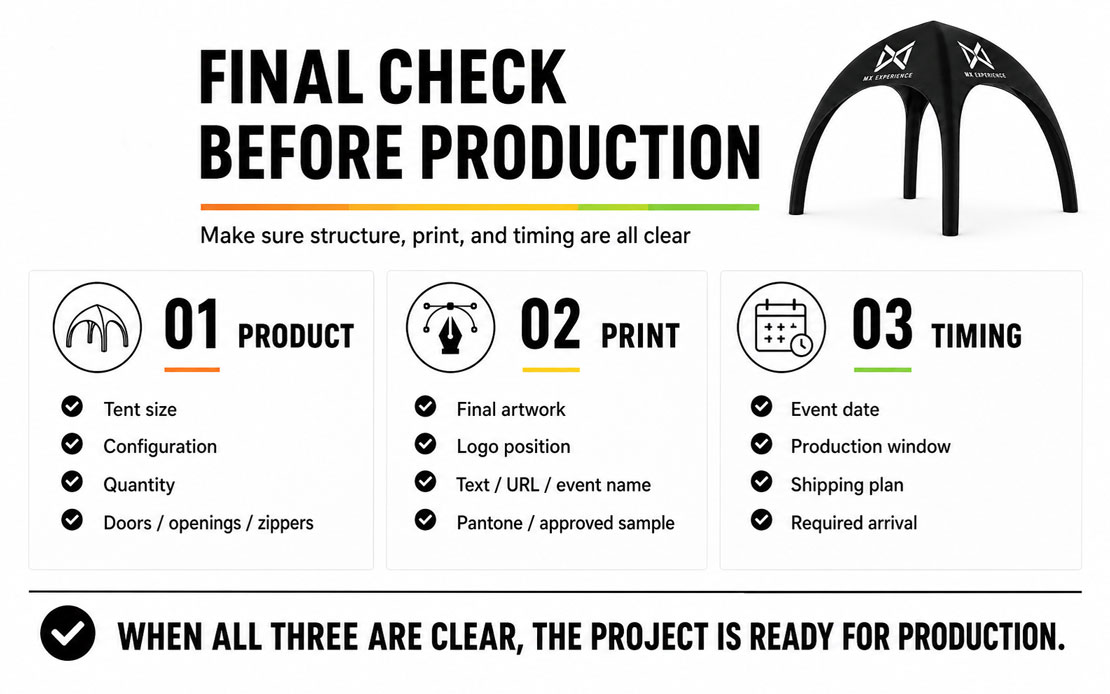
Custom Inflatable Tent Pre-Production Checklist
| Check | What the Buyer Should Confirm |
| Tent Size | Final dimensions |
| Configuration | Walls, doors, openings and zipper positions |
| 3D Visual | Overall appearance and branding balance |
| Production Artwork | Final printable content |
| Logo & Graphics | Exact surface, position and orientation |
| Brand Color | Pantone reference and approved physical sample |
| Text | Names, slogans, URLs and event information |
| Quantity | Final order quantity |
| Revision | Latest approved production version |
| Event Date | Actual event deadline |
| Delivery Plan | Production and shipping feasibility |
A good final review should answer three practical questions:
What exactly are we producing?
What exactly will be printed?
Can it arrive in time for the event?
If those three answers are clear, the project is ready to move forward.
FAQ
What should I check before ordering a custom inflatable tent?
Confirm the tent size, configuration, 3D visual, production artwork, logo and graphic positions, Pantone color reference, quantity and event date.
Also confirm that the production and shipping schedule can meet the required arrival timing.
Is a 3D visual enough to approve production?
No.
A 3D visual is used to review the overall appearance of the inflated tent.
Production artwork is still required to define the exact printed content, position and orientation on each production surface.
What artwork do I need for a custom inflatable tent?
Provide the best original artwork available.
Vector files are normally preferred for logos because they can be enlarged for large-format printing without the same pixelation associated with small raster images.
If no usable source file exists, MX can redraw the logo and send the rebuilt artwork back for review.
How should brand colors be approved before printing?
Start with the customer's Pantone reference.
MX normally prepares a physical color sample based on that target.
The customer reviews the sample before production, and the approved sample becomes the practical production color reference for that project.
What happens if I change the artwork or configuration after approval?
The production file should be revised.
The updated version should then be sent to the customer for confirmation before production continues.
Manufacturing should follow the latest approved production information.
When should I confirm the event date?
Confirm the event date before the production schedule is accepted.
MX checks the destination, order quantity and current factory production lead time, then works backward from the event date to determine whether production and shipping are feasible.
Final Check Before Production
Before approving a custom inflatable tent for production, make sure there are no open questions about the structure, artwork, color or timing.
You should know:
what will be produced, what will be printed on each important surface, which version is final, and whether the order can arrive before the event.
Once those points are confirmed, production has a much clearer reference.
MX is a design-led custom inflatable tent brand and supplier specializing in custom inflatable event tents.
We support buyers with size and configuration review, 3D visualization, artwork preparation, color confirmation, production coordination and delivery planning.