Common Problems When Buying Inflatable Event Products
Common Problems When Buying Inflatable Event Products
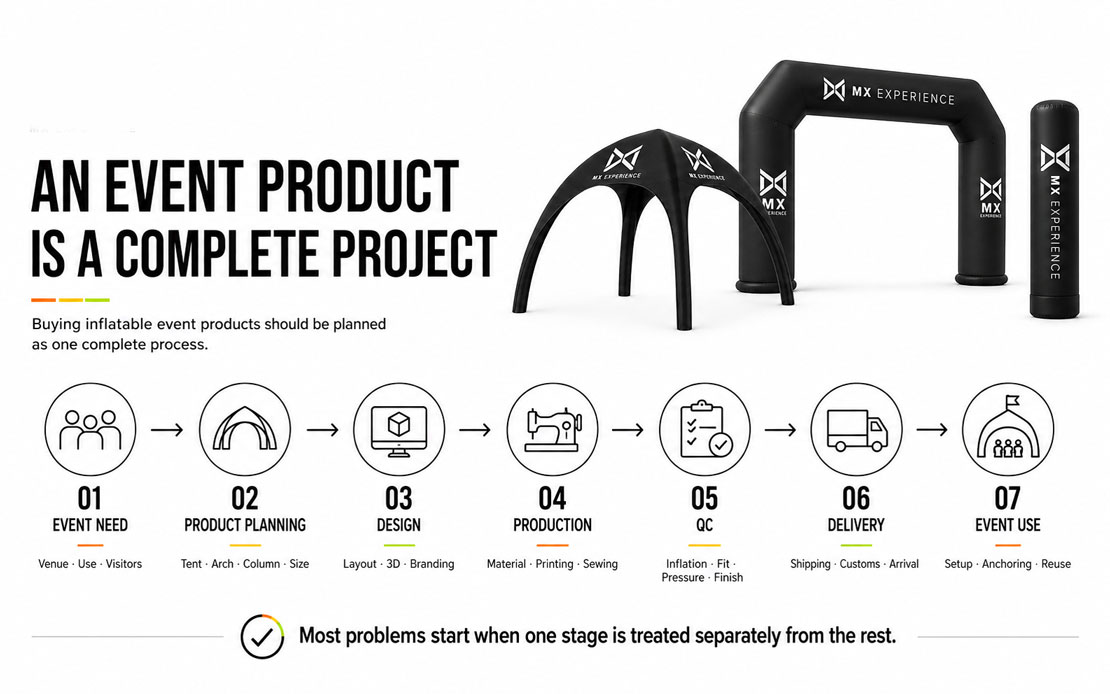
Buying inflatable event tents, arches, advertising columns or other custom event structures is not only about finding a supplier and comparing prices. Most problems happen because the project was not planned as a complete process from the beginning. A product may look correct in the quotation, but once it reaches the event site, the buyer may discover that the size does not fit the space, the printed color is different from the approved design, the structure is not suitable for the environment, or the delivery schedule was too tight.
This is why MX looks at inflatable event products as a complete event project rather than a simple product order.
EVENT NEED → PRODUCT PLANNING → DESIGN → PRODUCTION → QC → DELIVERY → EVENT USE
Start With the Event, Not the Product
The first challenge is deciding what the event actually needs. Many buyers start by asking for the price of a 4 × 4 m or 5 × 5 m inflatable tent, but size should not be the first decision. The better starting point is the event itself: how much space is available, what needs to be placed inside, how visitors will move through the area, how many staff will work there, and how visible the brand needs to be from a distance.
| Event Need | |
| Main branded area | Inflatable X Tent |
| Larger reception or display area | Long Inflatable Tent |
| Entrance or race start / finish | Inflatable Arch |
| Long-distance brand visibility | Advertising Column |
| Full activation area | Tent + Arch + Columns |
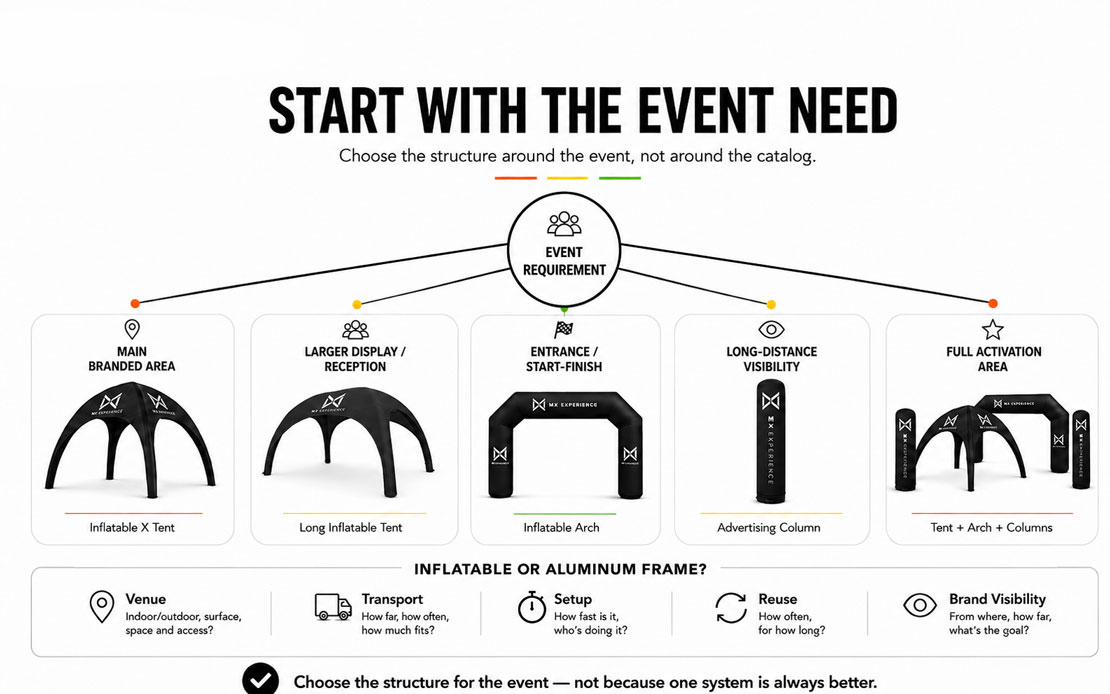
There is also an important question before choosing an inflatable structure: should the project use a traditional aluminum-frame tent instead? Aluminum tents are familiar and standardized, while inflatable structures are often easier to transport, quicker to set up and more visually distinctive. Neither option is automatically better. The right choice depends on the venue, setup conditions, transport, reuse frequency and branding goals.
At MX, we prefer to work from venue → internal layout → visitor flow → brand visibility → final size. This is part of our Design Before Production approach. The aim is to decide what should be made before production starts, rather than trying to solve layout problems after the product is already finished.
Finding a Supplier Is Easy. Finding the Right One Is Harder.
Once the product type and size are clear, the next challenge is finding the right supplier. There are many manufacturers online, so finding someone who can make an inflatable tent is not difficult. What is harder is finding a supplier who understands the full project and knows where problems normally appear.
A useful supplier check should go beyond price.
| What to Check | |
| Similar project experience | Shows whether they understand the structure |
| 3D and artwork support | Helps identify design problems before production |
| Material knowledge | Helps match the product to the environment |
| Color-control process | Reduces print differences |
| Inflation test before shipment | Reveals problems that cannot be seen while folded |
| Repair and replacement support | Matters after the first event |
MX was created around this exact gap. Our team comes from the inflatable event-product manufacturing side, so we understand the full chain from design and production to QC and delivery. Our role is not simply to pass an order to a factory. It is to help the buyer control the parts of the project that are easy to overlook.
The Biggest Risks Often Appear After Design Approval
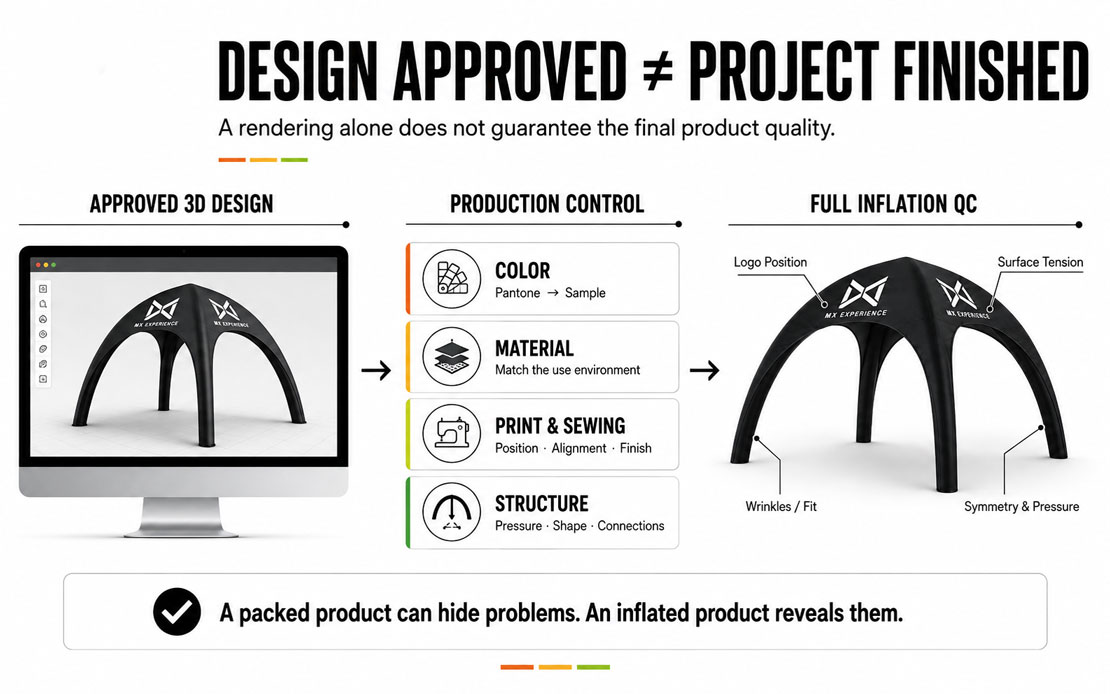
One of the biggest risks comes after the rendering has been approved. A 3D image can look correct on screen, but the finished structure still has to reproduce that design in fabric, printing, stitching and air pressure.
Color is one example. A screen preview is not enough for important brand colors. A more reliable process is:
PANTONE REFERENCE → PRINT SAMPLE → APPROVAL → PRODUCTION
Material also needs to be selected according to the actual use environment. An indoor exhibition, outdoor sports event, multi-city roadshow and long-term brand activation may all require different considerations. The buyer should think about sunlight, rain, repeated transport, storage, anchoring and frequency of use rather than asking only whether the product uses “Oxford fabric.”
QC is equally important. For inflatable structures, one of the most useful checks is simply to fully inflate the finished product before shipment. This makes it possible to inspect the real appearance of the structure, including logo distortion, surface tension, wrinkles, symmetry, pressure, door positions, sidewalls and connection points.
A packed product may look fine. A fully inflated product shows whether the design has actually been executed correctly.
Plan Backward From the Event Date
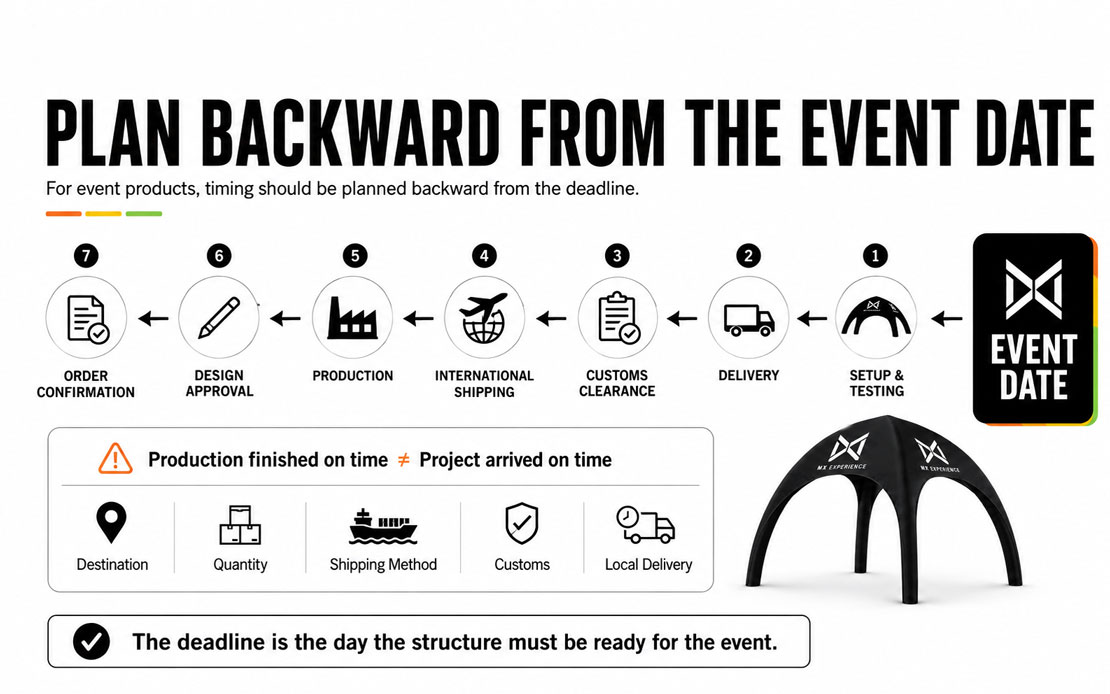
Another common problem is timing. Event products have a fixed deadline, so the project should be planned backward from the event date rather than forward from the order date.
EVENT DATE
← SETUP & TESTING
← DELIVERY
← CUSTOMS CLEARANCE
← INTERNATIONAL SHIPPING
← PRODUCTION
← DESIGN APPROVAL
← ORDER CONFIRMATION
This is why one of the first questions MX asks is the event date. Production time alone is not enough. International orders may also involve HS codes, import duty, VAT or GST, Incoterms, customs clearance and local delivery. A supplier can finish production on time and the project can still fail if shipping and customs were not planned early enough.
Delivery Is Not the End of the Project
The final stage is often ignored completely: what happens after delivery?
The person who places the order is not always the person who sets up the product. Event staff may need to understand how to inflate the structure, attach walls, anchor it outdoors, respond to unsuitable weather, deflate it correctly and store it between events. Clear instructions and simple setup videos can prevent many problems that are caused by incorrect use rather than manufacturing defects.
After-sales support should also be clear before purchase. Buyers should know whether printed covers can be replaced, whether spare parts can be ordered separately, how inflatable bladders can be repaired, what is considered normal wear and what is covered by warranty.
This is the main reason MX does not treat delivery as the end of the project.
What MX Is Really Helping Buyers Control
The inflatable event-product industry already has many factories. The real challenge for buyers is managing all the decisions between the first event idea and the final setup.
MX focuses on connecting those decisions:
DESIGN BEFORE PRODUCTION
MANUFACTURING-SIDE EXPERIENCE
ONE PROJECT, ONE TEAM
BUILT AROUND THE EVENT DATE
The goal is not to make the purchasing process more complicated. It is to make the important decisions earlier, so the project becomes easier to control later.
When buying an inflatable tent, arch or advertising column, the most useful question is therefore not only:
“Who can make this product?”
It is:
“Who can make sure the product works for my event from the first idea to the day it is used?”