Inflatable X Tent Size Guide: 3x3m to 8x8m Sizes for Events
What Size Inflatable Tent Do I Need? Inflatable Tent Size Guide for Events
The right inflatable tent size starts with the space available at the event, then the space required inside for displays, furniture, equipment, staff and customer movement.
Do not choose a custom inflatable tent from price or nominal dimensions alone.
A 4 × 4 m tent can work well for one activation and feel too restrictive for another. The difference is what needs to happen inside that footprint.
For MX projects, we start with three practical checks:
Can the tent fit the site?
Will the interior layout work?
Can the structure be transported, installed and stored efficiently?
Answer those first. Branding scale and visual presence come afterwards.
Tent sizing is only one part of the buying decision. For materials, customization, costs and supplier evaluation, see our complete inflatable event tent buyer's guide.
1. Start With the Available Event Footprint
The event site sets the first limit on tent size.
Before comparing a 3 × 3 m, 4 × 4 m or larger custom inflatable X tent, confirm the exact area allocated by the venue or event organizer.
Check the usable footprint, not just the overall venue dimensions.
Consider:
- neighboring booths and structures;
- barriers and fences;
- entrances and access routes;
- fixed site equipment;
- poles, trees or site furniture;
- required clearance;
- space needed during setup.
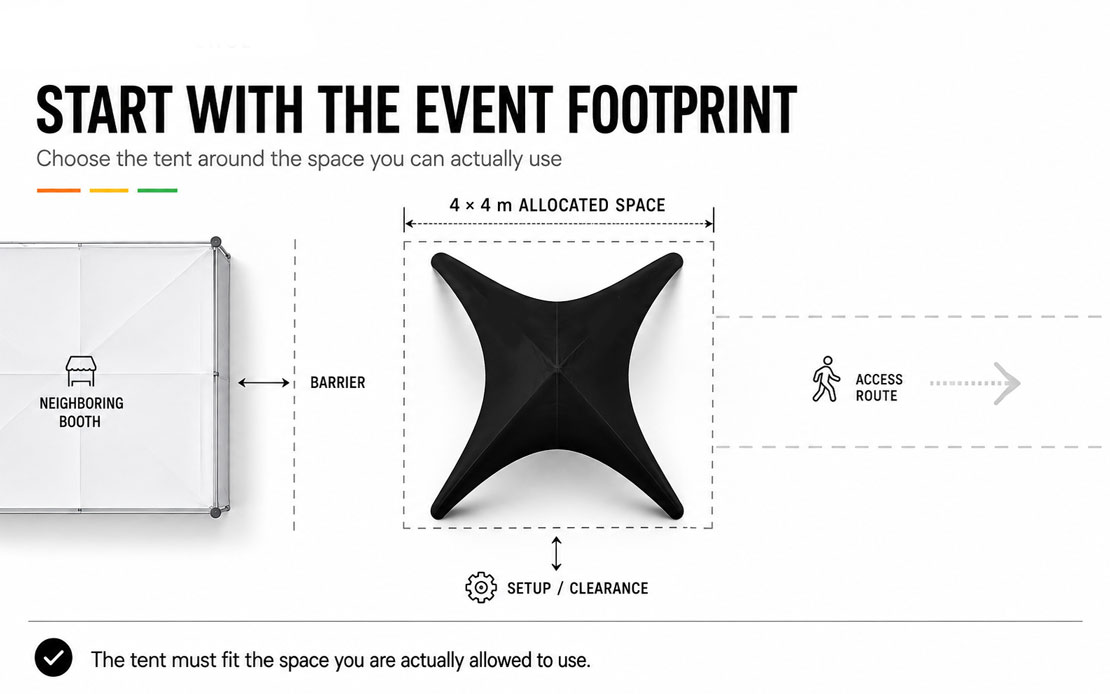
If the organizer assigns a 4 × 4 m footprint, a preferred 5 × 5 m structure is not a practical option.
This is the first sizing rule MX uses when discussing an event project: start with the space you are actually allowed to use.
Venue requirements also vary between events and locations. Permitted footprints, access conditions, anchoring requirements and setup rules should be confirmed with the organizer before the final tent size is approved.
Do not design the event around a tent that does not fit the site.
For larger events, choosing the right size is not only about total square metres. Buyers should also compare whether one large inflatable tent or multiple smaller tents better match the venue layout and future reuse needs.
2. Nominal Tent Size Is Not the Same as Usable Interior Space
A stated tent size describes the structure. It does not automatically describe a completely usable rectangular interior.
This matters with inflatable X tents because the inflatable columns occupy physical space.
A 4 × 4 m inflatable tent should not automatically be planned as an empty 16 m² room.
The usable layout depends on:
- how the tent dimensions are measured;
- the inflatable column profile;
- wall configuration;
- door and entrance positions;
- furniture and displays;
- equipment;
- circulation routes.
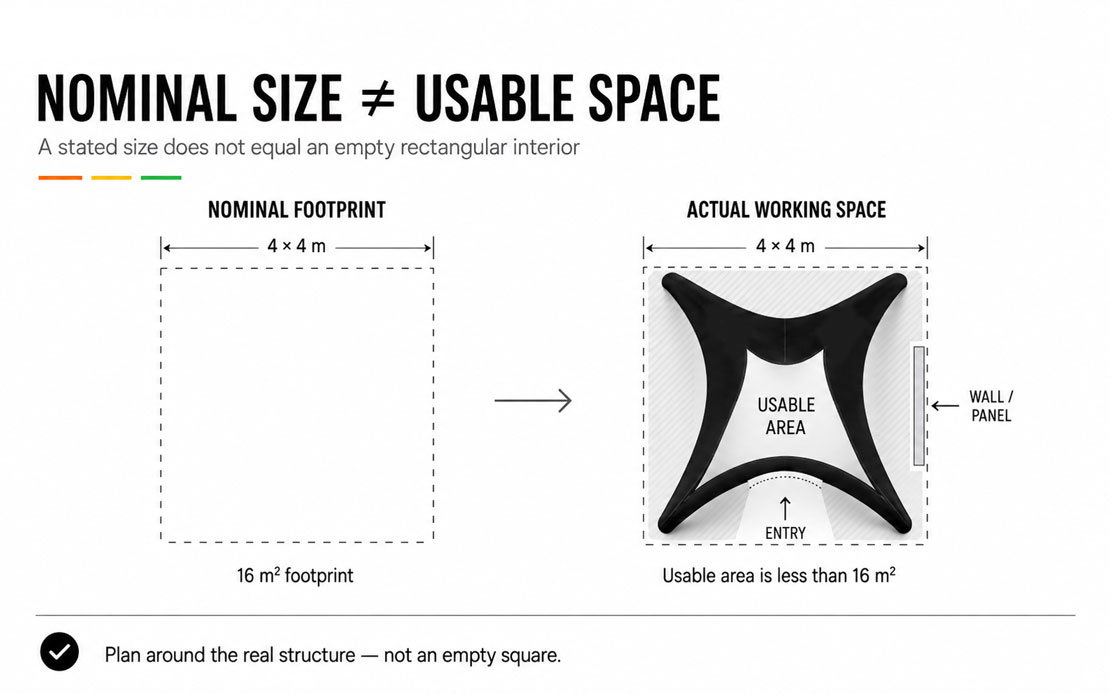
For an exhibition booth, a counter, product display and screen can already occupy a substantial part of the interior before staff or visitors enter.
This is why MX reviews the tent footprint together with the planned interior rather than treating the stated size as an isolated specification.
Confirm How the Tent Dimensions Are Measured
Before comparing sizes from different suppliers, confirm exactly what the stated dimensions refer to.
Do not assume that every supplier defines a 4 × 4 m inflatable structure in exactly the same way.
Ask:
What exactly does the stated tent dimension measure?
Confirm this before finalizing the interior layout, walls, doors and branding.
A misunderstanding at the sizing stage can later affect display positioning, access and the overall balance of the finished space.
3. Inflatable Tent Size Chart: 3 × 3 m to 8 × 8 m
MX X Tents are available from compact 3 × 3 m structures through larger 8 × 8 m event formats.
The table below contains the standard MX X Tent size reference. These dimensions help buyers understand the physical scale of each structure, but they should not be used as the only basis for choosing a size.
MX X Tent Standard Size Reference
| Metric Size | Approx. Imperial Size | Side Height | Center Height |
| 3 × 3 m | 10 × 10 ft | 1.95 m | 2.5 m |
| 4 × 4 m | 13 × 13 ft | 2.1 m | 2.7 m |
| 5 × 5 m | 16 × 16 ft | 2.5 m | 3.3 m |
| 6 × 6 m | 20 × 20 ft | 3.0 m | 3.95 m |
| 7 × 7 m | 23 × 23 ft | 3.2 m | 4.75 m |
| 8 × 8 m | 26 × 26 ft | 3.6 m | 5.4 m |
These are MX product specifications, not estimated dimensions.
Use the table to compare structural scale. Then check the selected size against the actual event plan.
Two buyers can select the same 4 × 4 m tent and still require very different layouts.
One may use a single counter and a compact product display.
Another may need two tables, product racks, a monitor, storage and several staff members working inside.
The tent size is the same. The spatial requirement is not.
4. Plan the Interior Before Choosing the Tent
List everything that needs to remain inside the tent during the event.
Typical items include:
- product displays;
- counters;
- tables;
- screens;
- seating;
- demonstration equipment;
- promotional materials;
- storage;
- staff working areas.
Place these fixed elements into the layout first.
Then evaluate the space that remains.
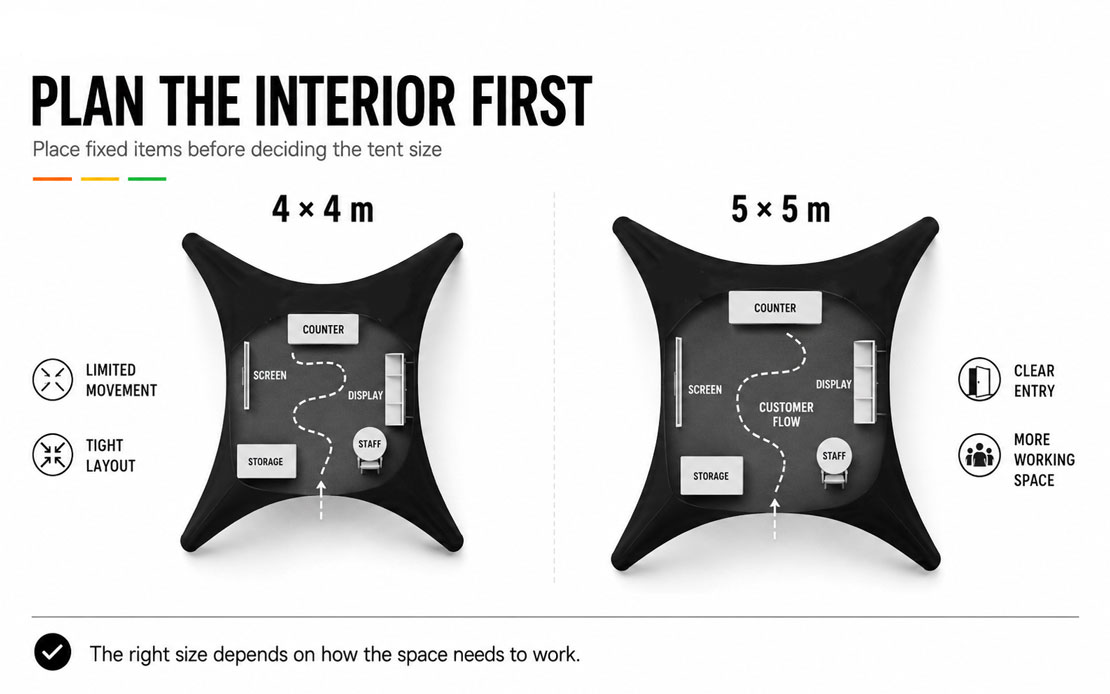
This produces a more reliable sizing decision than choosing from appearance or price alone.
For example, if a 4 × 4 m tent needs to contain two tables, product displays, equipment and four staff members, the working area can already become restricted before customers enter.
Choosing the smaller structure only to reduce the purchase cost does not remove those requirements.
It moves the problem into the event.
This is one of the most common sizing problems seen during project discussions: the structure is reduced first, but the required furniture, equipment and operating space remain unchanged.
Place Fixed Items First
A common question is how many people a tent can hold.
For a working event tent, that is not the right place to start.
Tables, displays, counters and equipment remain in position while people use the space.
Plan those first.
Then check whether staff and visitors can still move and work normally.
Consider Regular Occupancy After the Layout
Once the fixed items are positioned, consider how many people regularly need to use the space.
A tent with two staff members and occasional visitors has different requirements from one used for product demonstrations, customer meetings or hospitality.
The useful question is not how many people can physically stand inside the tent.
It is how many people can use the space normally while the required equipment and displays remain in position.
5. Leave Enough Space for Access and Circulation
Everything fitting inside the tent is not enough.
The space still has to work during the event.
Customers need to enter, move around displays, stop to speak with staff and leave without constantly stepping around furniture or equipment.
Staff also need clear access to products, storage and working areas.
That is why custom inflatable tent design should be reviewed as an operating event space, not simply as an exterior structure.
Leave deliberate room around entrances, side doors, counters, displays, equipment and customer interaction areas.
A layout that fits on paper still needs enough room to work in real use.
This becomes particularly important in exhibition booths, brand activations and motorsport paddocks, where people and equipment continue moving through the structure throughout the event.
A crowded layout can make a correctly sized tent feel too small.
A well-planned layout can make the same footprint work much more effectively.
6. Do Not Choose a Larger Tent for Appearance Alone
A larger tent creates more physical presence. It does not automatically create a stronger brand experience.
Moving from a 4 × 4 m structure to a 6 × 6 m structure makes sense when the event genuinely requires more display space, equipment, working area or customer interaction space.
Increasing the size only because the larger structure looks more impressive requires more careful judgment.
A large tent with limited activity or content can feel underused.
The scale of the structure should match the scale of the activation.
Branding also needs to be reviewed when the tent size changes.
A graphic layout designed for a 4 × 4 m tent should not simply be enlarged for a 6 × 6 m structure without checking logo proportion, white space and viewing distance.
For that part of the project, see our guide on how to make a custom inflatable tent look professional at an event.
MX treats tent size and branding as connected design decisions, but function comes first.
If the event does not need the additional footprint, going larger is not automatically an upgrade.
7. Check Transport, Site Access, Setup and Storage
The event site may support a large tent while the logistics do not.
Before approving a 6 × 6 m, 7 × 7 m or 8 × 8 m structure, check how the tent will reach the site and what happens before and after the event.
Review:
- vehicle capacity;
- packed dimensions;
- loading and unloading access;
- entrance width;
- available setup area;
- available handling staff;
- ground conditions;
- storage space after use.
For example, a 7 × 7 m structure can fit the allocated event area and still be the wrong choice if the packed tent is difficult to move through the venue access or the event team cannot handle it efficiently.
The same principle applies in motorsport environments.
A paddock may provide enough physical footprint for a larger inflatable tent, while vehicles, tools, equipment access and team working areas place tighter limits on the practical structure size.
Storage also needs to be considered before purchase.
Before MX confirms a larger structure, the 3D tent design should be reviewed together with transport, installation and storage conditions.
The largest tent you can order is not always the largest tent you can operate efficiently.
8. Common Inflatable Tent Sizing Mistakes
Choosing the Smallest Size Just to Save Money
Reducing the tent size can reduce the initial purchase cost, but it does not reduce the space required by the displays, furniture and staff.
If the layout is already tight before visitors arrive, the smaller structure has not solved the problem.
It has moved the problem into the event.
Choosing a Large Tent Based Only on Preference
More space is useful only when there is a reason to use it.
The site, event activity and branding should justify the larger footprint.
Sizing the Tent Only Around People
Do not count people first.
Plan displays, furniture, equipment and working areas, then check whether the remaining space supports the people who need to use it.
Treating Nominal Size as Fully Usable Space
Do not draw an empty square from the nominal dimensions and assume every part of it is freely usable.
Plan around the actual inflatable structure and interior configuration.
Forgetting Transport, Setup and Storage
A structure can work in a 3D layout and still be impractical if the team cannot transport it, move it through the venue, install it efficiently or store it afterwards.
9. Inflatable Tent Sizing Checklist
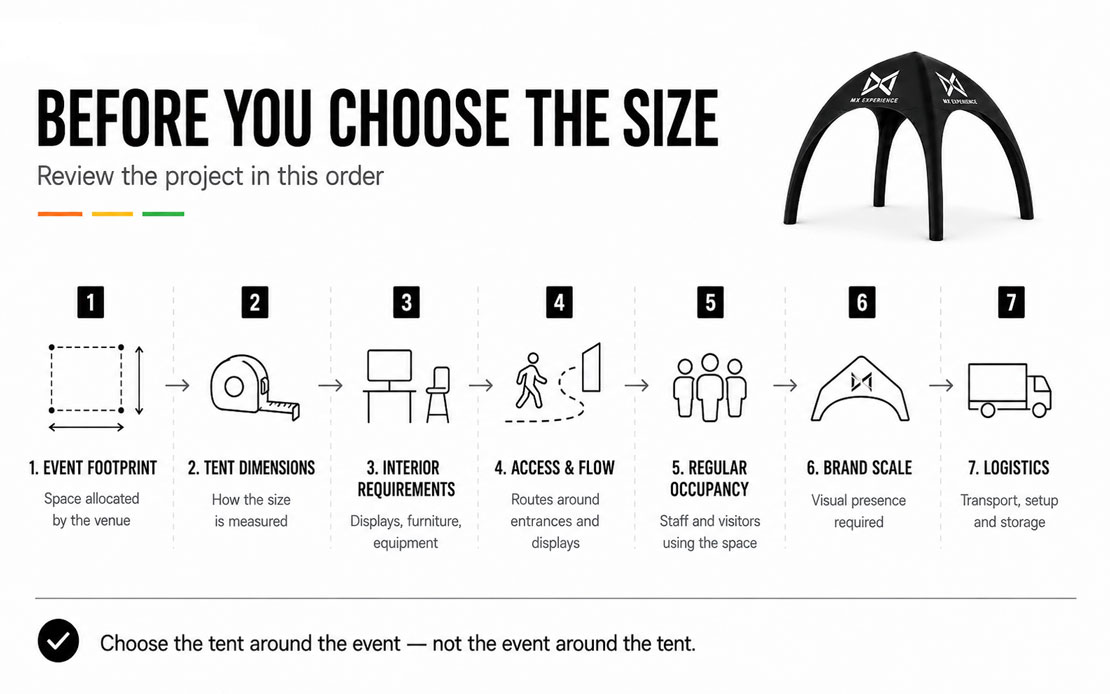
Before approving the final tent size, check the project in this order:
1. Event footprint
Confirm the actual space allocated by the venue.
2. Tent dimensions
Confirm what the supplier's stated measurements refer to.
3. Interior requirements
Place displays, furniture, counters and equipment.
4. Access and circulation
Leave usable routes around entrances, displays and working areas.
5. Regular occupancy
Check how many staff and visitors need to use the remaining space at the same time.
6. Brand scale
Check whether the structure provides the visual presence required for the activation.
7. Logistics
Confirm transport, site access, setup and storage.
MX uses the same sequence when reviewing a custom inflatable tent project before production.
The tent size should follow the event requirements, not the other way around.
Frequently Asked Questions
What size inflatable tent do I need for my event?
Start with the event footprint, then plan the furniture, displays and equipment.
Leave space for access and movement, check regular occupancy and confirm transport and setup conditions.
The right size is the structure that allows the event to operate properly without creating unusable or unnecessary space.
Is a 4 × 4 m inflatable tent really 16 m² of usable space?
No. Do not automatically treat it as a completely usable 16 m² rectangular interior.
Inflatable columns occupy physical space, while doors, walls, displays, equipment and circulation routes affect the usable layout.
Confirm how the supplier defines the stated dimensions before finalizing the plan.
Do inflatable beams reduce usable interior space?
Yes. Inflatable beams occupy part of the structure's footprint.
The exact effect depends on the beam profile and tent design, so plan around the actual structure rather than an empty square based only on nominal dimensions.
Should I choose a larger inflatable tent for better brand visibility?
Not on size alone.
A larger structure works best when the event activity, displays and branding support the increased scale.
If the tent size changes, review the branding proportion instead of simply enlarging the existing artwork.
What should I put in the layout before choosing an inflatable tent size?
Place fixed items first: displays, tables, counters, screens, equipment, storage and staff working areas.
Then reserve space for entrances, access and customer movement.
What should I check before ordering a large inflatable tent?
Check the event footprint, interior layout, site access, packed size, vehicle capacity, setup area, handling requirements and storage.
The structure needs to work throughout transport, installation, event use, removal and storage.
Conclusion
Choose the tent around the event, not the event around a size selected in advance.
Start with the available site. Plan the displays, equipment and working areas. Leave enough room for normal movement. Then decide whether additional size improves the way the event works or simply creates unused space.
Finally, make sure the structure can be transported, installed and stored efficiently.
That is the practical way to choose an inflatable tent size.
Planning an Exhibition, Brand Activation or Motorsport Setup?
MX is a design-led custom inflatable tent brand and supplier specializing in custom inflatable event tents.
Send us your event footprint, logo and basic layout requirements. MX can review the tent size, branding layout and setup requirements and prepare a free 3D concept before production.